
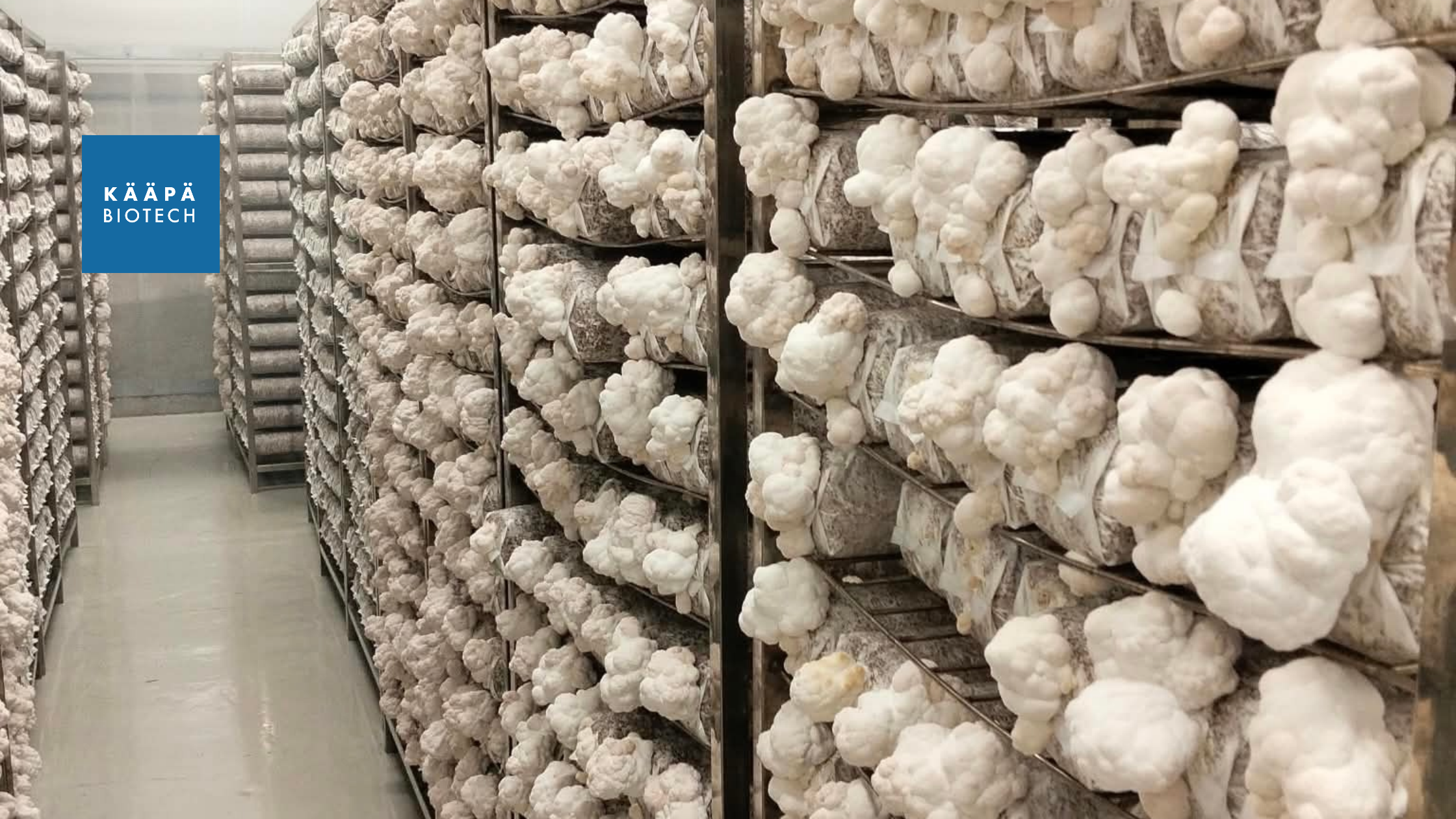
The Lion’s Mane mushroom (Hericium erinaceus) is one of the most recognisable mushrooms in the world. With its unusual white appearance and cascading, hair-like spines, it looks very different from the mushrooms we usually find in supermarkets.
But what exactly is Lion’s Mane, where does it grow, and how is it cultivated?
At KÄÄPÄ Biotech, we work with Lion’s Mane in Finland, combining mushroom cultivation with modern production methods. From carefully managed growing conditions to the preparation of finished mushroom extracts, every stage involves attention to the mushroom itself. In this article, we explore the fascinating world of Lion’s Mane and take you behind the scenes of our Finnish production.
What Is Lion’s Mane Mushroom?
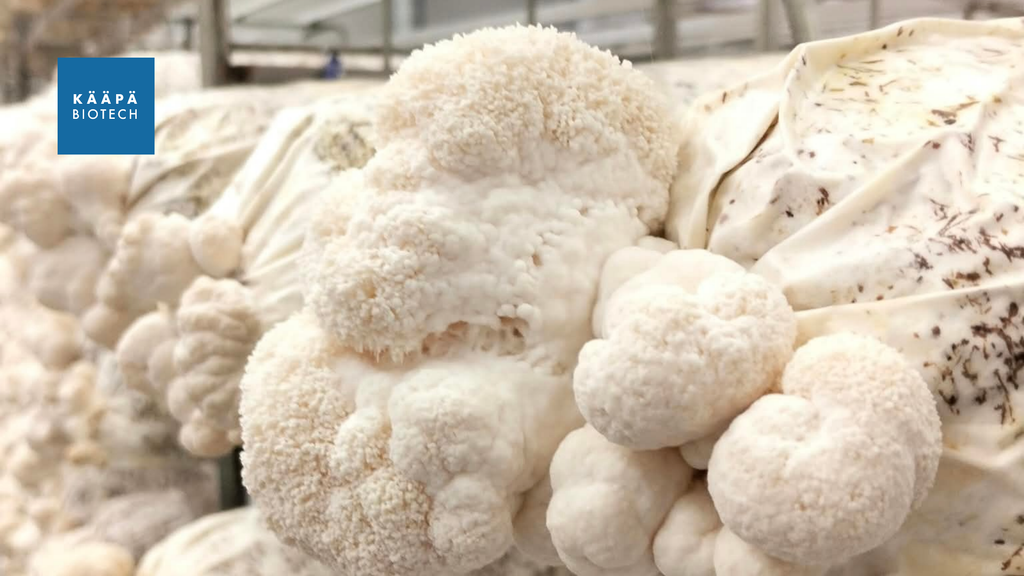
Lion’s Mane, scientifically known as Hericium erinaceus, is an edible mushroom belonging to the Hericium genus. Unlike familiar mushrooms with caps and stems, Lion’s Mane develops rounded clusters covered in long, soft-looking white spines. These distinctive structures give the mushroom its name, as they resemble a lion’s mane. It is also known by other names, including the bearded tooth mushroom, pom pom mushroom and yamabushitake in Japan. Lion’s Mane naturally grows on hardwood trees, including beech and oak.
It can be found in parts of Europe, Asia and North America. Its unusual appearance has made it particularly interesting to mushroom enthusiasts, growers, chefs and researchers.
Where Does Lion’s Mane Mushroom Grow?
In nature, Lion’s Mane grows on hardwood trees, often appearing on damaged or decaying wood. Like many fungi, it plays a role in the natural decomposition process, helping break down woody material. However, finding Lion’s Mane in the wild is quite different from growing it commercially. In the United Kingdom, wild Lion’s Mane is a protected species and should not be harvested. Cultivated mushrooms provide an alternative source for food and ingredient production.
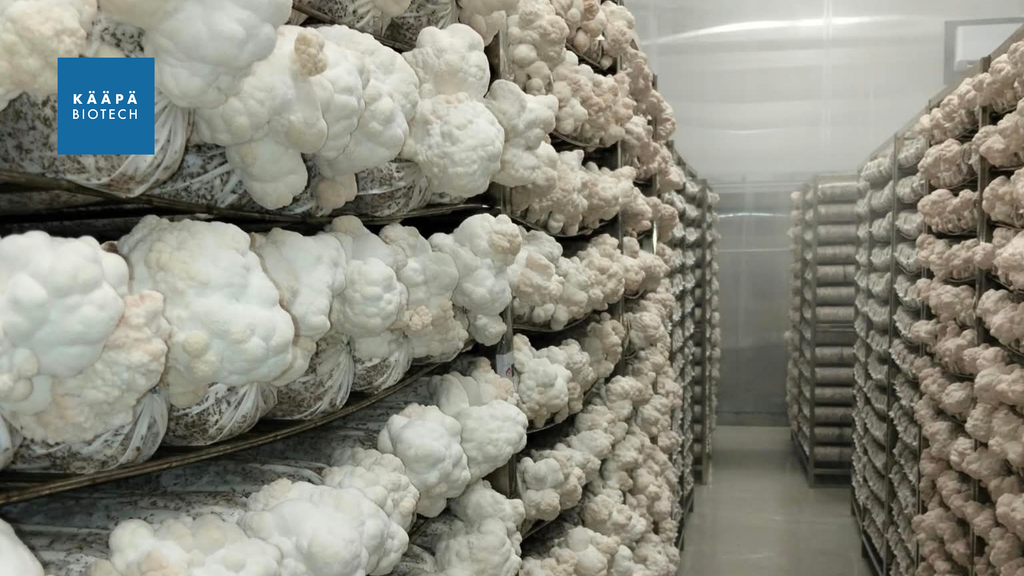
Today, Lion’s Mane can be grown in controlled indoor environments, where temperature, humidity, airflow and other conditions can be carefully managed.
Growing Lion’s Mane Mushroom in Finland
Finland is home to extensive forests and a long tradition of working with natural resources. At KÄÄPÄ Biotech, our headquarters and production facility are located in Karjalohja, southern Finland. Our work combines knowledge of fungi with carefully managed cultivation and production processes. Growing Lion’s Mane requires an understanding of how the mushroom develops. The process begins with mycelium, a network of fine fungal threads that grows through a suitable substrate. Under appropriate conditions, the fungus can produce the visible mushroom structure known as the fruiting body.
Indoor cultivation allows growers to manage several important environmental factors, including:
- Temperature throughout the growing cycle
- Humidity and moisture levels
- Fresh-air exchange and carbon dioxide
- Lighting and growing conditions
- Inspection of developing mushrooms
These factors are monitored throughout cultivation. Our aim is to create suitable conditions for the mushrooms to develop while maintaining an organised and traceable production process.
From Mycelium to Lion’s Mane Fruiting Body
One of the most interesting parts of mushroom cultivation is watching the fruiting body develop. The mycelium grows through its substrate before the mushroom begins to form. Over time, the recognisable white structure of Lion’s Mane appears. As it develops, its characteristic hanging spines become more visible. The distinction between mycelium and fruiting body is also important when discussing mushroom ingredients.
Mycelium is the network of fungal threads involved in growth and nutrient absorption. Fruiting body is the visible mushroom structure that develops during the fungus’s reproductive stage.
At KÄÄPÄ Biotech, we use Lion’s Mane fruiting bodies, rather than mycelium, to manufacture our mushroom extracts. This is one of the details that helps customers understand exactly which mushroom material is used in the finished ingredient.
What Happens After Lion’s Mane Is Harvested?
Harvesting the mushroom is only one part of the production journey. Following cultivation, the mushroom material moves through additional processing stages.
At KÄÄPÄ Biotech, our production process includes drying and grinding the harvested fruiting bodies before extraction. We use our NordRelease® extraction technology to process mushroom material into ingredients for further formulation. Depending on the intended product, Lion’s Mane extracts can be prepared in liquid or powder formats.
Our production process also incorporates quality-control procedures, including testing raw materials, monitoring production conditions and using external laboratory testing. These steps help document the material being processed and its characteristics.
For companies sourcing mushroom ingredients, understanding these stages provides valuable information about how a raw mushroom becomes a finished ingredient.
Why Does Mushroom Origin Matter?
When looking at mushroom products, it is easy to focus only on the species name. However, understanding where the mushrooms originate and how they are processed can provide a more complete picture.
Useful questions include:
- Where was the mushroom grown?
- Which part of the mushroom was used?
- How was the material processed?
- Is information about testing available?
- Can the ingredient be traced through production?
At KÄÄPÄ Biotech, transparency and traceability form part of our approach to mushroom production. Our Finnish operations provide an opportunity to connect cultivation knowledge with manufacturing and quality documentation. For product developers and businesses, this information can be especially relevant when evaluating ingredients for new formulations.
How Is Lion’s Mane Mushroom Used?
Lion’s Mane is a versatile mushroom with several culinary and commercial applications. Fresh Lion’s Mane has a distinctive texture and mild flavour. It can be sliced, cooked in a pan or incorporated into various dishes. The mushroom is also used as an ingredient in a growing range of commercially manufactured products.
Depending on processing and formulation, Lion’s Mane can appear in:
- Mushroom powders
- Liquid mushroom extracts
- Capsules and other supplement formats
- Mushroom coffee and beverage products
- Other food and nutraceutical formulations
These formats differ in how the mushroom material is prepared, which is why ingredient specifications and production information are important.
Discover Our Finnish Lion’s Mane Production
Behind every Lion’s Mane mushroom is a fascinating cultivation process. From the development of mycelium to the formation of its distinctive white fruiting body, this species offers an opportunity to explore how fungi grow and how they can be cultivated.
At KÄÄPÄ Biotech, we are proud to work with Lion’s Mane in Finland, combining cultivation expertise, extraction technology and an interest in understanding mushrooms. Our work continues from our Finnish production operations to the development of ingredients for businesses around the world.
Interested in learning more about our ingredients?
Explore our Lion’s Mane extracts, discover our production and quality processes, or contact the KÄÄPÄ Biotech team to discuss your product requirements.